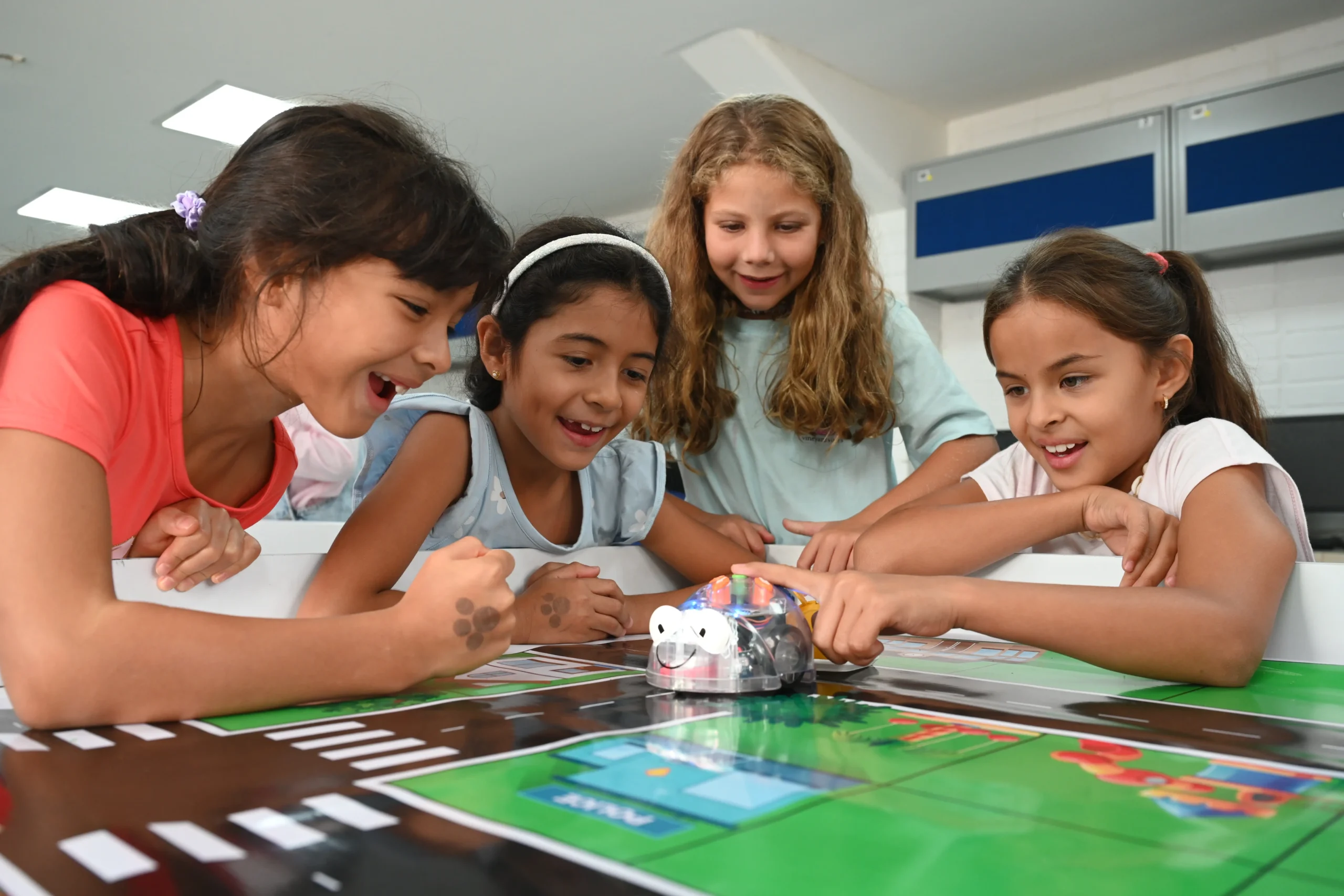
At our school, robotics is more than just a subject—it is an adventure of discovery, creativity, and wonder. During ICT class periods, from second to fifth grade, students explore the world of computational thinking through experiences designed to develop logical reasoning, spark curiosity, and strengthen their ability to solve real-life problems.
Everything begins in second grade, where learning is built from the most essential elements: the body and space. With friendly robots called Beebots, which are programmed manually without the need for screens, children learn about directionality, sequential logic, and observation. Each Beebot challenge becomes a small mystery to solve: How can we get from point A to point B while navigating obstacles? Students propose hypotheses, design strategies, program the robots, and evaluate the results. Once they master this stage, they connect the Beebots to tablets to work on more complex challenges using model layouts.
In third grade, the journey moves toward visual coding. This is where Scratch comes into play—an intuitive platform that allows children to create their own 2D video games. The process then continues with KODU Game Lab, where they design their own 3D games. Excitement grows as their characters, animations, and stories come to life simply by dragging and dropping code blocks. But the fun doesn’t stop there: students also work with devices like Makey Makey, a tool that transforms electrically conductive objects into interactive controllers. This allows them to control their video games with fruit, modeling clay, or aluminum foil, all while learning about energy and electrical circuits.
The process becomes even richer in fourth grade, where students work with Micro:bits—small programmable boards that allow them to experiment with sensors, motors, and moving structures. Here, technology connects directly to real life. An alarm that rings every time someone opens the cookie jar? A step counter to measure distances accurately? These are just a few of the ideas students have transformed into functional prototypes, applying logic, programming, and plenty of creativity.
And in fifth grade, one of the most anticipated moments arrives: building real robots! Using Lego Mindstorms EV3, students work in teams to tackle real-world challenges. They have designed prototypes ranging from cranes capable of removing debris after landslides to intelligent canes equipped with sensors that assist people with visual impairments. Each project begins with a real need, grows through imagination, and takes shape with motors, sensors, and Lego components—all programmed by the students themselves.
This journey through robotics in elementary school is much more than a sequence of technological activities—it is an experience that embodies the spirit of deep learning. Students not only learn to program or build; they develop lifelong skills: they observe, ask questions, collaborate, solve problems, and reflect. At every step, technology becomes a tool for thinking critically, creating with purpose, and connecting with the world.